



The rate of sea-level rise is now more than 4 millimeters (0.16 inches) per year, having more than doubled since 1993–2002. Scientists estimate that this figure may go up to 10 millimeters (0.39 inches) per year in the near future. The inundation of coastlines and islands will affect human and animal habitats alike.
A new study, published in Science, has laid out projections of which land animals and habitats will be most affected by rising sea levels. The study seeks to provide guidance for conservation efforts by pointing out important refuges for affected animals.
Improving data for better conservation
Rising seas threaten land animals by flooding their habitats, alongside climate pressures such as heat and drought. Species confined to small islands or narrow coastal ranges may be at increased risk, with little habitat left to retreat into. Conservation planners need to know which species are at the greatest risk of habitat loss from sea level rise (SLR), where it will occur and when. However, current assessments may be lacking.
The authors of the new study write, "Since SLR exhibits substantial spatial and temporal variability, nuanced projections of when and where inundation may occur are thereby critical for assessments. This is challenging because the inundation at a specific location is influenced by local-scale factors, such as vertical land movements (land subsidence/uplift) and dynamic variations in regional sea levels (e.g., due to uneven thermal expansion/contraction).
"Species-level habitat data, including elevational ranges and habitat preferences, can refine broad geographic distributions into more precise estimates of habitat exposure, enabling conservation actions tailored to species-specific risks."
Previous global and island assessments often used simpler assumptions about sea-level rise or inferred species losses from total land loss. The team involved in the new study hopes to provide a better guide by conducting a global, species-specific assessment of SLR habitat impacts on 34,120 land vertebrate species (90% of known land vertebrates) and exploring potential conservation plans.
New insights on species vulnerable to sea-level rise
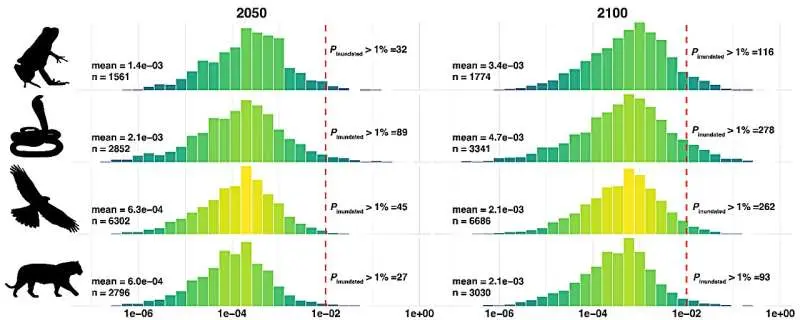
The researchers combined suitable habitat maps for all included land vertebrate species and modeled sea level rise in 2050 and 2100 under five emissions scenarios, accounting for regional sea levels, tides and sinking or rising land. They then estimated each species' habitat loss and mapped high-priority remaining habitats that could support affected species. Effects from storm surges, hurricanes and salt spray were not included, although they represent an additional risk that could damage habitats before regular tidal flooding occurs.
The study found that roughly 14,300–15,300 of the 34,120 species studied could experience partial habitat inundation, depending on the emissions scenario. The researchers say that 57%–63% of birds, 47%–52% of mammals, 28%–36% of reptiles and 20%–24% of amphibians would be affected. Under the highest-emissions scenario, 109 species could lose more than 10% of their habitat by 2100, compared with 18 by 2050.
The study authors write, "Although SLR is predicted to affect a greater proportion of birds and mammals than that of amphibians or reptiles, species impacted in the latter two groups, particularly reptiles, will experience nearly twice the average proportional habitat loss of birds and mammals."
The worm lizard (Amphisbaena littoralis), Catalina chuckwalla (Sauromalus klauberi) and Restinga toadlet (Melanophryniscus setiba), in particular, are projected to lose ~50% of their habitats by 2100 under the high-emissions climate scenario. And migratory birds are particularly vulnerable when breeding, nonbreeding and resident habitats are analyzed separately, despite lower total habitat loss. Species categorized as "already-threatened" could lose, on average, about five times the share of habitat lost by species classified as "least concern."
Regional hotspots for affected species
The study also identified specific regions with the most at-risk species. Southeast Asia emerged as a major hotspot for threatened and small-range species, largely due to inundated areas harboring high numbers of threatened species. The Amazon delta leads in the number of species whose habitats overlap projected flooding, with more than 1,000 square kilometers (386 square miles) of inland area inundated by 2050.
Islands are also at a greater risk due to smaller geographic ranges for habitats. The study authors write, "Islands host many endemic species, and their coastline-to-interior ratio exposes a greater share of inland areas to rising tides. Consequently, even minor habitat loss from modest SLR can increase the extinction risk of island-dwelling species."
The study also identifies priority refuges, of which more than 96% lie outside currently protected areas. The researchers hope that governments will use the maps to guide protected-area expansion toward habitats likely to remain above water and land-use planners will avoid developing areas expected to become important refuges.
They say efforts like captive breeding may be necessary for species facing large losses. Coastal defenses may also need to be assessed for wildlife impacts because barriers can obstruct movement of some species and squeeze habitats against rising waters.
Written for you by our author Krystal Kasal, edited by Lisa Lock, and fact-checked and reviewed by Robert Egan—this article is the result of careful human work. We rely on readers like you to keep independent science journalism alive. If this reporting matters to you, please consider a donation (especially monthly). You'll get an ad-free account as a thank-you.
Publication details
Zhong-Wen Jiang et al., Safeguarding global terrestrial vertebrate species from future sea level rise, Science (2026). DOI: 10.1126/science.aed5772
Who's behind this story?

Krystal Kasal
Freelance science writer with Master's in physics. Five years clinical research and physics education experience. Science communicator. Full profile →

Lisa Lock
BA art history, MA material culture. Former museum editor, paramedic, and transplant coordinator. Editing for Science X since 2021. Full profile →

Robert Egan
Bachelor's in mathematical biology, Master's in creative writing. Well-traveled with unique perspectives on science and language. Full profile →
© 2026 Science X Network
Citation: About 15,000 land vertebrate species could lose habitat to sea-level rise by 2100 (2026, November 11) retrieved 11 November 2026 from https://phys.org/news/2026-11-vertebrate-species-habitat-sea.html
This document is subject to copyright. Apart from any fair dealing for the purpose of private study or research, no part may be reproduced without the written permission. The content is provided for information purposes only.