



The Mitre railway terminal in the Retiro neighbourhood of Buenos Aires is a great place to reflect on the long, dynamic, sometimes troubled relationship between Argentina and the UK. Built from 1909-1915, it was designed by the British architects Eustace L Conder, Roger Conder and Sydney G Follet together with the engineer Reginald Reynolds – the steel superstructure etched with the words “Made in Liverpool” – for the Central Argentine Railway, one of the “big four” British-owned operators in Argentina founded in the 19th century.
Outside the station is a miniature Big Ben’s tower, still called by many the Torre de los Ingleses (English Tower) – given to the nation for its centennial by the large local “Anglo” community – but officially renamed the Torre Monumental after the Falklands War. Opposite this, across the Avenida del Libertador, is the Monument to the Malvinas Fallen, a black marble wall containing the names of 649 Argentine troops killed in the 1982 war.
Go back 300 years and this area was a slave market – overseen, for a time, by the South Sea Company, headquartered in London. Blood runs deep here, and ever since Drake came a-plundering, the British, in particular the English, have been known as “piratas”.
But the British also brought lots of things to Argentina that are now considered national icons, including pedigree beef cattle, sheep, and sports such as rugby union, polo and, of course, football. For the very first season of the First Division, in 1891, there were just five clubs, all with British associations. Two teams were declared joint winners: Old Caledonians and St Andrew’s, the latter tied to a school established by Scots immigrants – where I worked as an English teacher from 1994-1996.
Ever since the 1806-1807 British invasions of Buenos Aires, its residents, the porteños, call most Britons “Ingleses” – but if you dig a bit, it’s the English who Argentines feel strongest about (and they love the Welsh Patagonians).
The rivalry goes back a long way, takes many forms, and can get tense at times. But to celebrate the big “40th anniversary” match tonight, we thought we’d host a less heated contest and consider: Which country scores higher when it comes to a holiday?
The categories
- Nature and landscapes
- Cities and nightlife
- Food and wine
- Weather
- Sightseeing
- Warmth of the welcome
- Value for money
- Going to the match
Nature and landscapes
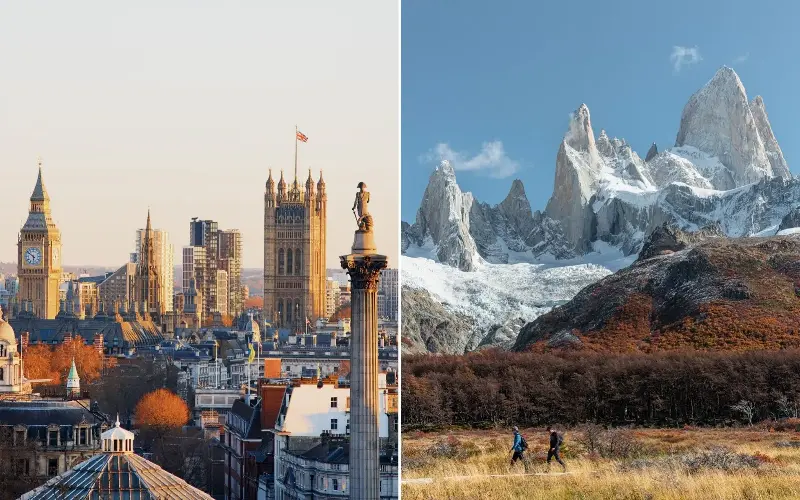
The world’s eighth-largest country is about 2,300 miles top to toe, straddling the Tropic of Capricorn and containing the highest sections of the Andes, as well as pampas, rainforests, the sierras of Córdoba, several red-rock canyons, Mendoza’s winelands and Patagonia’s steppe and semi-desert. The Iberá wetlands are a smaller version of the Pantanal, home to the maned wolf, capybara, caiman, marsh deer and, following its reintroduction, jaguar. With more than a thousand bird species, including large, eye-catching species like the jabiru stork, flamingo, roseate spoonbill and Andean condor, Argentina is birdwatching heaven.
England is one of the most nature-depleted nations on earth and has no true ancient wildwood. Comparing Argentina’s tremendous Iguazú Falls to England’s Cautley Spout would be like comparing Lionel Messi to Vinnie Jones.
Winner: Argentina
Cities and nightlife
For breadth of choice, London, Liverpool, Bristol, Manchester, York, Plymouth et al knock Argentina for six. Even more hyper-centralised than England, Argentina has clustered the vast majority of its cultural assets and hedonistic hangouts in its capital. Córdoba and Rosario have music and nightlife scenes, but other cities in the interior offer very little.
But Buenos Aires is a thrilling nocturnal city, unlike London, with both late dining/drinking and all-night clubbing and carousing. Buenos Aires’ cafés are a world away from our queue-for-your-plastic-cup chains, and its corner bars can compete with our loveliest pubs.
Winner: Argentina
Food and wine
Lacking a sophisticated national cuisine, Britain has become an exciting anything-goes gastronomy superpower. You can find great South and East Asian, European, American and Middle Eastern cuisine in our larger cities, and Michelin-starred eateries in rural villages. Argentina has come to like fine dining in recent years, and you can easily get pretentious, pricey fare in Palermo.
But its main strength is honest, hearty cooking, whether meat-centred (as served at grills called parrillas) or just everyday pastas, salads, fish-and-chip-type dishes at neighbourhood restaurants. Service is old-school, meaning smarter waiters, swifter delivery, pride on the job and free bread (and even a brandy on the house for nice clients).
Winner: Draw
Weather
See “Nature and landscapes”. Obviously, a country of this length and girth is going to have a great variety of climates. The central area around Buenos Aires has four true seasons, though winters are milder than London’s and summers are scorching and intensely humid.
The Andean north-west has a rainy season in the southern summer (December to March) and a dry season in our summer. Patagonia and Tierra del Fuego are colder and windier, but generally not as wet as the Lake District or western Scotland – and snow cover is partial away from the Andes. Argentina’s beaches are not the best in South America, but you can go to them and be certain of sunshine.
Winner: Argentina
Sightseeing
One of Argentina’s more intriguing facets, for British visitors, is the number of places with links to our little island – from churches and pubs to the clipped accents of fourth-generation Anglo-Argentines in the Zona Norte, to the gorgeous Palace of Running Waters in Buenos Aires on Avenida Córdoba (symbolic of the 1891 crisis that almost sank the Barings Bank).
The capital is a great place for exploring eclectic architecture, seeing half a dozen top-notch galleries and museums, visiting the city parks and Ecological Reserve. But Argentina has wiped out much of its indigenous history and has not been great at conserving even the colonial and postcolonial structures of the past 500 years. England has greater antiquity and a far larger middle class, which has resulted in a lot of national heritage, protected for ordinary people.
Winner: England
Warmth of the welcome
Outside London, where cool distance (or passive rudeness) is the way people get along without intruding on one another’s lives, England is a fairly friendly country – and the farther north you go, the warmer the people become. But Englanders are incurious, and when a holidaying Argentine mentions his origin in an English pub, say, or a coffee shop, it’s likely to be met with indifference.
Argentines are less weary of tourists, and many are avid Europhiles – for complicated reasons – and some out-and-out Anglophiles. The few thousand English tourists who make it to Buenos Aires or, even more so, places like Salta, Tucumán, Mar del Plata and Córdoba, will find Argentines, from city or country, extremely welcoming and engaged with our culture. They love English music, films, literature and humour. We might like theirs, of course, if we knew anything about it.
Winner: Draw
Value for money
For transport, food (restaurant or supermarket), drink (alcoholic or not), holiday lets, cinema and theatre tickets, holiday experiences like bike hire or horse riding and almost every category you can think of, Argentina is less expensive than England – and many things are half the price or less.
For posh hotels, car hire and domestic flights, the market is more on a similar level, but you can still find better value for money in Buenos Aires than in London, Manchester, Newcastle or Leeds. Locals fork out inflated prices for cars and branded clothing, but they are not of huge concern to most short-term visitors.
Winner: Argentina
Going to the match
Tonight’s grudge match in Atlanta will see rival fans trying to outsing and out-shout each other. England’s might win in numbers, though lots of Argentines reside in the US. But when it comes to seeing a match in each nation’s respective home stadia, Argentines – who are not confined to numbered seats – make a lot more noise and generate far more energy.
The Superclásico (derby of derbies) between Boca Juniors and River Plate is a gladiatorial encounter, with fervour at a ferocious pitch and mutual hate whistled so loudly it can actually be painful on the eardrums. Clubs like Independiente, San Lorenzo and Racing also attract big crowds, and the build-up across Buenos Aires as the supporters – hinchadas – travel on packed buses is frenzied and edgy. A day at a local match is as Argentine an experience as any tango lesson or outdoor asado (barbecue).
Winner: Argentina
The verdict
The score is what Thomas Tuchel’s nightmares are made of: 6-2 (with Draws worth half a point). All the things Argentina gets rightly ridiculed for – economic chaos, corrupt leaders, bent cops, even gamesmanship in sports – are everyday issues for people born in the country, but they don’t affect foreign travellers beyond the need to keep an eye on currency exchange rates and opportunistic muggers.
When it comes to pleasure and leisure, whether in a national park or a tango salon, dining out or going to the beach, Argentina has more to offer – and charges less for it, and gives of itself more generously. One of the world’s superpowers when it comes to topography and geography, it makes England look and feel rather grey, soggy and bereft of wilderness or wildlife.