



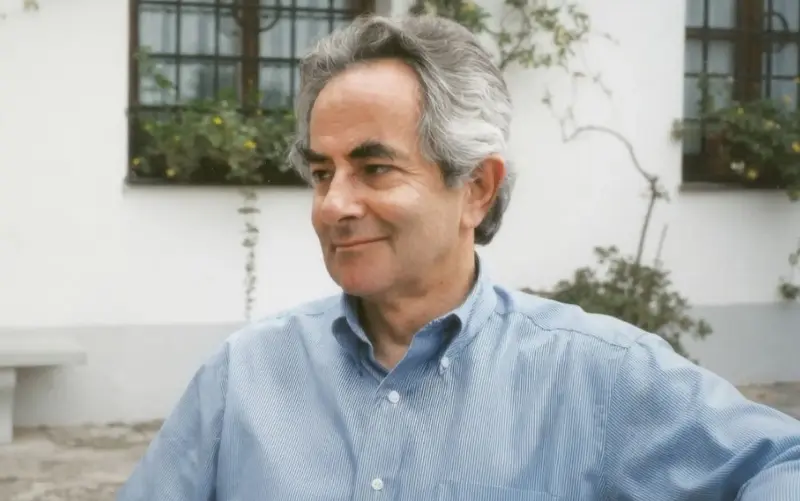
What is it like to be Thomas Nagel?
Within the first few days of any philosophy, neuroscience or even theology course taken in the past several decades one would certainly have encountered the name “Thomas Nagel”. One of the most famous and important philosophers of his generation, his seminal essay, “What is it like to be a Bat?”, was published over 50 years ago.
This week, Nagel was awarded the Berggruen prize for philosophy. The $1m award is given annually to an individual whose ideas have profoundly shaped human self-understanding and advancement in a rapidly changing world.
Nagel’s win clearly signals the growing significance of philosophy in the techno-futurist world of artificial intelligence. What exactly is it that we can learn from Nagel?
Ever since René Descartes, philosophy has, to an astonishing degree, focused on the question of how we might relate mind and matter. Modern philosophy has, on the whole, tended to assume that the world can be described entirely by the physical sciences. That mind can be simply reduced to matter. The partisans of this “materialism” posit that even conscious life is simply an anomaly that occurred through the mechanisms of the brain.
This means that the feelings I have when I look at William McTaggart’s paintings of Machrihanish Bay, or when I kiss the person I love, or indeed when I hear a little bat whoosh past me at night, are not really real since conscious experience is reducible to physical processes.

I might very well believe that I experience these sensations, but in actual fact the sensations are simply some kind of made-up story that has developed as a useful tool of evolution.
But if, for example, someone were to hook me up to a machine that could do all sorts of whizzing and lighting up, giving an accurate image of what happens to my brain when I perceive the colour blue, would we be any closer to explaining what the experience of blue is like?
Similarly, if we hooked up my little bat friend Rufus to the same machine, as he saw colours for the first time, would we have any understanding of what it was like to be him?
The dominant position in philosophy of science would have you believe that there is no “reality” to that experience. However, aside from the fact that this is a rather new conviction in the history of ideas, this account of the world also seems extremely contrary to common sense. In comes Nagel. According to him, the reductionist cult which tries to explain consciousness in terms of material processes is totally off-piste.
In his essay on bats, Nagel suggests that there is something about the bat’s experience of “batness” that we do not, and even cannot, know even though we think that the bat is indeed conscious. In doing so, Nagel draws attention to the idea that there is something about what it is like to be a bat that can’t be captured by any kind of physiological or behavioural description of the bat. And so, there is something about subjective conscious experience that is beyond the scope of pure matter.
It is extraordinary, says Nagel, that these philosophers “can regard the appearance from the inside of what is going on in his own mind as an illusion, overridden by a theory constructed from the outside. Only a philosopher could convince himself of something so implausible”.
This materialist viewpoint is how the consciousness of artificial intelligence will be justified by most philosophers. Some philosophers and public intellectuals, such as David Chalmers and Richard Dawkins, have already speculated that AI will soon be conscious (or perhaps already is).
With opinion pieces by philosophers springing up in all the major newspapers, research articles and projects at all the major universities around the world, books on books by public intellectuals such as Michael Pollan and Rocky Scopelliti all centring around the nature of consciousness in the AI debate, Nagel’s work has experienced an exigent revival.

Scientists, programmers, and engineers are not fully equipped to describe the reality that they discover, or indeed create. It is an incontrovertible fact that the declaration that AI is conscious depends not on science – for science cannot define consciousness – but entirely on philosophy.
We may not know what it is like to be Thomas Nagel anymore than we do a bat, but his win is indicative of a broader cultural shift. That the Berggruen prize has been awarded to a scholar who deals principally with categories that are important for current technological debates is surely a confirmation that the digital world must equally be understood philosophically.
After all, “one of the legitimate tasks of philosophy,” according to Nagel, “is to investigate the limits of even the best developed and most successful forms of contemporary scientific knowledge.”
The fact, however, that the prize has been awarded to Nagel and not, say, to Chalmers may also be indicative of a return to a common-sense approach to consciousness.
With philosophers parodically asking “What is it like to be Conscious AI” and “Can you think like a Computer”, Nagel offers us a useful counter-narrative, a philosophically legitimate way of rejecting the obvious nonsense that machines could be sentient.
Elise Morrison is a PhD student at the University of Cambridge