



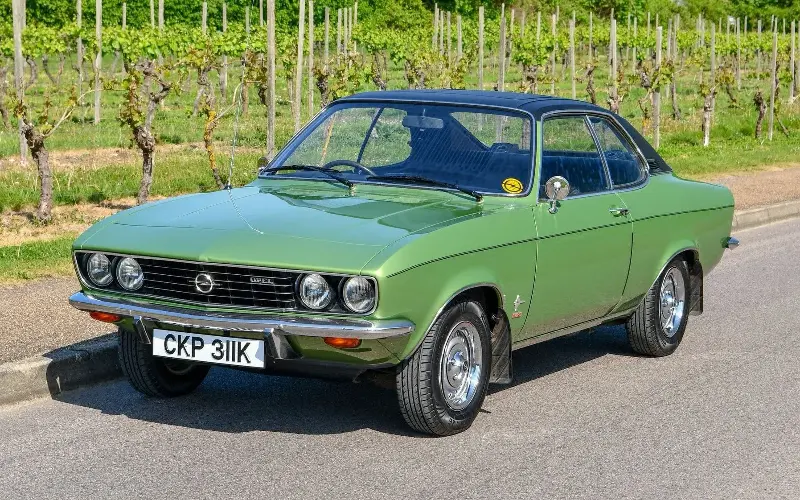
In 1972, an Opel Manta SR Rallye Automatic represented the high life. The facia, adorned with the finest woodgrain, the vinyl roof and the svelte coupé lines, denoted a car that seemed more than a cut above the Ford Capri Mk1. Today, Alex Baker’s metallic green Manta is believed to be one of only eight surviving SR models – and the sole example with an automatic gearbox.
The Manta resulted from Opel’s need to revitalise its image, for in the 1960s too many German motorists regarded it as a purveyor of solid, but very boring, saloons. The GT of 1968 represented a major change, but that was an exotic and expensive machine. As the story goes, Chuck Jordan, Opel’s director of design, on secondment from the US, asked his colleagues the following year: “What are we doing against the Capri?”
Opel would later tell the press that the Manta was not conceived as a Capri rival, as its development commenced in 1966, but the Ford’s arrival in 1969 almost certainly accelerated the German firm’s coupé programme. Jordan instructed his deputy, George Gallion, to create the bodywork in a mere six weeks. The name Manta had already been decided, and its emblem was inspired by Gallion seeing footage of a manta ray.
The Manta debuted in September 1970. Opel stated that it joined “our existing line-up as an effective addition and to meet a newly emerging need”. It shared a floorpan with the Ascona A saloon, which also debuted that year, but the two Opels had very different images. An Ascona was for a respectable Darmstadt insurance salesman; a Manta was for the provincial young hedonist.
The fact that the Manta resembled no previous Opel enhanced its appeal in its home market, where sales in 1971 reached 56,200. As for overseas markets, Buick dealerships sold the Manta in the US, while Opel GB initially offered the 1.6-litre De Luxe or the 1.9-litre Rallye. One gem of sales copy targeted the would-be groover with: “Why should bachelors have all the fun?” for the Manta was “wild and beautiful for five”.
Just in case the potential buyer thought the Manta too frivolous, there was room for “your wife and family in superb comfort”, while “there are few performance cars with a boot as big as the Manta’s”. This newspaper found it “well-finished”, and Hot Car thought the Manta felt like a sports car – “responsive and taut”. Car regarded it as suited to “the rapidly expanding ranks of young marrieds with a swarm of sprogs at heel”.
By 1972, the SR Rallye cost £1,543, while a Capri 2000 GT XLR was £1,377, although the two had very different images. Some Manta owners dismissed the Ford as a vehicle for “medallion men”, while they appreciated fine wines and Belgian chocolates. The Sunbeam Rapier H120 for £1,624 was another British alternative to the Manta, but it looked slightly ungainly compared with the Opel.
There was also the Vauxhall Firenza Sport SL for £1,372, a form of in-house rival since Opel and Vauxhall were both part of the General Motors empire, although the two marques had separate dealerships and model line-ups. The Manta’s svelte appearance was known to induce envy in certain Vauxhall outlets, with one salesman complaining that the Firenza resembled a “bubble-top Viva”.
The Manta B replaced the Manta A in July 1975 after 498,553 units, with more than 170,000 sold in the US. Baker owned two variants of the Opel in the 1980s – “and I vowed to buy another”. He finally acquired the green SR at the end of 2024, after waiting for its previous owner to sell it for more than a year, and it is possibly the sole surviving automatic version.
Baker found that his Manta attracts many comments, usually along the lines of: “What is it?” He regards the optional automatic gearbox as “very smooth and precise”, although he prefers the manual box as better suited to the 1.9-litre engine. As for the Opel’s most appealing aspect, “it has to be its appearance”.
The Manta both altered Opel’s image and embodied a sense of corporate pride; one 1973 UK-market advertisement stated: “From the ruins of World War II, back to No. 1 in Germany.” A metallic green SR was ideal for the driver who craved “a real 100mph machine” – and who had the ambitions to own a Mercedes-Benz 280 CE coupé but had only a Ford Capri income.
Thanks to Alex Baker and Daniel Bevis of Classic.Retro.Modern. Magazine.
We use the fascinating howmanyleft.co.uk for figures of surviving examples but some cars present more of a challenge than others, so the figures are rarely authoritative. Some pre-1974 records were lost before the DVLA centralised the process, while some cars have their model type misnamed on the V5 registration documents. A further issue is the omission of the exact model name or generation, or distinction between saloon and estate bodystyles.