


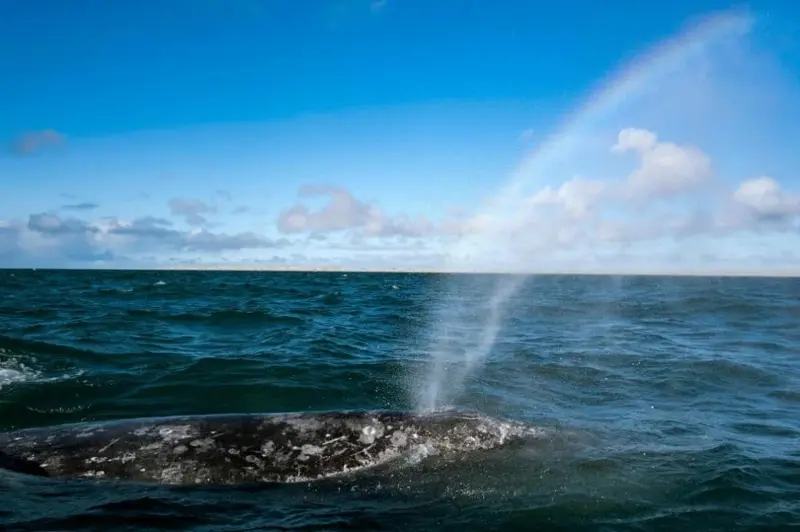
The gray whale population has declined drastically.
According to conservationists, the rapid melting of sea ice in Alaskan waters has depleted benthic organisms, the primary food source for gray whales. Many individuals have been found stranded and emaciated, showing signs of starvation after long migrations.
Besides the impact of climate change, experts believe that many other factors contribute to the decline in gray whale populations, including collisions with ships, oil spills, microplastic pollution, algal blooms, and hunting.
Estimates suggest the Pacific gray whale population has declined from around 20,000 individuals in 2019 to under 13,000 this year, while mortality rates continue to rise.
According to scientists , between 2,500 and 8,000 individuals could die in 2026 alone, enough to be considered a "catastrophic mass mortality event".
Determining the exact number of dead whales is difficult because researchers can only count those that have washed ashore.
From 2006 to 2023, an average of about 43 whales were reported stranded each year, but this number increased to 179 in 2025. In the first half of this year alone, 146 whale carcasses have been reported.
Studies also suggest that the number of whales that die offshore may be many times higher than the number of carcasses found on land.
The main reason is likely the sharp decline in food sources due to the continuous shrinking of sea ice around Alaska as a result of climate change.
Conservationists are calling for urgent action.
Conservation groups have submitted a petition to the U.S. National Oceanic and Atmospheric Administration (NOAA), requesting that gray whales be reinstated as protected species under the Endangered Species Act (ESA).
According to them, this is a necessary measure to strengthen conservation efforts, even though the chances of it being approved are not high.
Gray whales were on the brink of extinction in the 1970s due to overhunting. After years of protection, their populations recovered significantly and they were removed from the ESA's protected species list in 1994.
However, conservation organizations argue that this decision has revealed many limitations as the impacts of climate change become increasingly apparent.
Experts warn that the environment is changing at a rate that could outpace the adaptive capacity that helped gray whale populations recover in the past.
In addition to food scarcity, many whales also bear the marks of collisions with boats or propellers.
At the same time, conservation organizations assess that the expansion of oil and gas exploration in the area increases the risk of pollution and puts further pressure on the whales' habitat.
NOAA is expected to respond to the petition to reinstate gray whales on the protected species list within the next month.