



The James Webb telescope has discovered ice clouds on the gas giant planet Epsilon Indi Ab, opening up new insights into atmospheres and the search for extraterrestrial life.
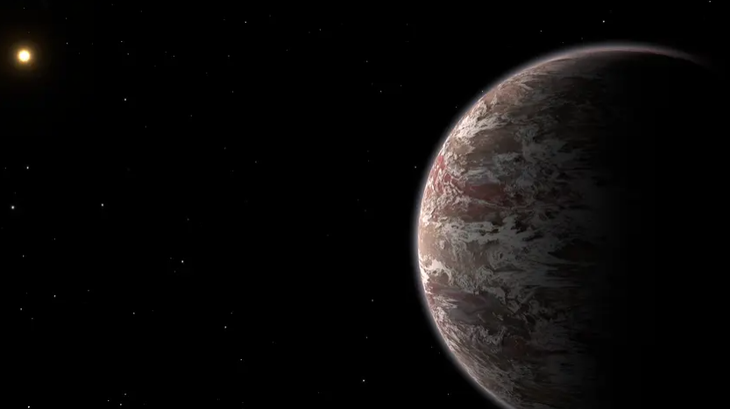
Illustrative image of the planet Epsilon Indi Ab, with water clouds above its predominantly ammonia atmosphere - Photo: EC Matthews, MPIA/T. Müller, HdA
Astronomers have just discovered unexpected ice-water clouds on a giant gas exoplanet far from Earth, thanks to observations from the James Webb Space Telescope (JWST).
This discovery is considered to revolutionize our current understanding of the atmospheres of exoplanets and open new avenues of research in the search for extraterrestrial life.
The exoplanet has been identified as Epsilon Indi Ab, orbiting the star Epsilon Indi A in the constellation Indus in the southern sky.
According to PhD student Bhavesh Rajpoot (Max Planck Institute for Astronomy - MPIA), this planet has a mass of about 7.6 times that of Jupiter, but its size is comparable to the largest planet in the Solar System.
Epsilon Indi Ab is located about four times the distance from Jupiter to the Sun, away from its host star. Because the host star is smaller and cooler than the Sun, the planet's surface temperature is estimated to be between -70 and +20 degrees Celsius (200-300 Kelvin). Even so, the planet is warmer than Jupiter thanks to residual heat from its formation billions of years ago.
Observing low-temperature gas giants like Epsilon Indi Ab is challenging because most exoplanets discovered so far orbit very close to their host stars and have high temperatures. To overcome this limitation, the research team used the MIRI (Mid-Infrared Rift) instrument on JWST in combination with a coronagraph to block light from the host star, thereby obtaining a direct signal from the planet.
The data obtained revealed a surprise: atmospheric ammonia levels were lower than predicted. Scientists believe the cause may be the presence of thick, uneven water ice clouds, obscuring the ammonia levels below. These clouds are thought to have a structure similar to cirrus clouds in the Earth's upper atmosphere.
According to Elisabeth Matthews (MPIA), the study's lead author, JWST is opening up the possibility of observing planets similar to our Solar System in detail. However, to study Earth-like planets at a deeper level, more advanced generations of telescopes will be needed in the future.
In the near future, NASA's Nancy Grace Roman Space Telescope (scheduled for launch in 2026-2027) is expected to continue supporting the detection and study of these water-ice cloud structures. Scientists are currently refining observation techniques with the JWST, aiming to get closer to the goal of searching for Earth-like worlds and signs of life outside the Solar System.