


A frigid world drifting through space, without a ruling star or sunrise, yet possessing an atmosphere that changes over time.
Thanks to the James Webb Space Telescope (JWST), astronomers have for the first time directly confirmed that water clouds on an exoplanet can thicken and thin, revealing astonishing weather patterns on a world just 7.5 light-years from Earth.

New discoveries about weather on the coldest celestial body ever known.
Scientists have been monitoring the weather on WISE 0855, a celestial body belonging to the coldest group of brown dwarf stars ever known, using NASA's James Webb Space Telescope.
The research team, led by Brittany Miles, a researcher at the Stewart Observatory at the University of Arizona (USA), observed this Jupiter-sized object for 11 consecutive hours.
Every 15 minutes, the James Webb telescope records a spectrum of light from WISE 0855. This allows scientists to distinguish changes in water clouds from signals from gases carried to higher altitudes by heat within the atmosphere.
The research results, published in The Astrophysical Journal, provide the most detailed look to date at how this frigid celestial body has changed over time.
Notably, this is the first time scientists have directly confirmed that water clouds on another world can change in thickness, a familiar phenomenon in Earth's weather systems.
"This is the first time we've been able to confirm that water clouds are thinning and thickening over a world so close to us," Miles said.
According to this researcher, before James Webb became operational, scientists relied primarily on optical measurements to study similar celestial bodies.
However, that method struggled to distinguish the individual effects of clouds, chemical composition, and temperature. With his advanced spectroscopic analysis capabilities, James Webb helped the research team separate these factors more clearly.
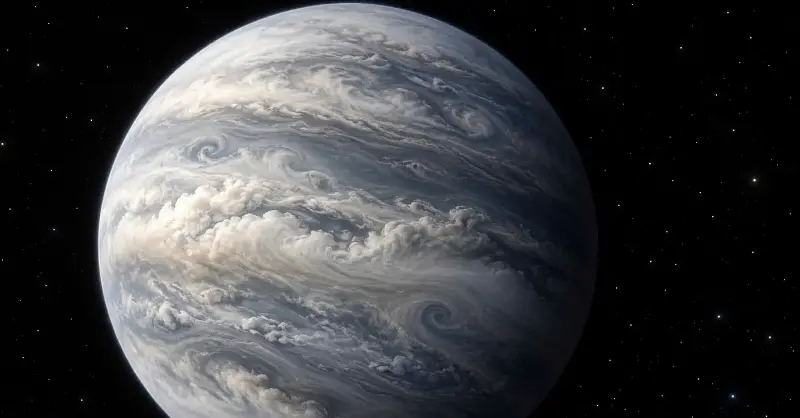
WISE 0855: A frigid world nestled between planets and stars.
Brown dwarfs are celestial bodies that do not have enough mass to sustain hydrogen fusion reactions in their cores like normal stars.
Instead of continuously generating energy through fusion reactions, they gradually release the residual heat from the formation process.
Brown dwarfs are generally more massive than planets, but the smallest objects in this group make the boundary between star and planet difficult to define. WISE 0855 is a prime example of that boundary region.
This celestial body has a mass approximately twice that of Jupiter, while its size is nearly comparable to the giant gas planet of our Solar System.
It resembles a giant planet drifting in space without a host star to provide light.
The temperature of WISE 0855 is around minus 8 degrees Celsius. This temperature is lower than the average temperature on the Earth's surface, making it one of the coldest atmospheric environments that astronomers can study in detail.
Without light from a nearby star, WISE 0855's atmosphere remains active thanks to heat escaping from within the celestial body.
This heat creates convection, in which hotter matter moves upwards and colder matter moves downwards.
This very mechanism offers scientists a unique opportunity to understand how the internal heat of a vast world governs cloud formation and weather phenomena.
However, deciphering this atmosphere is not simple. The light that the telescope receives must pass through many layers of gas and clouds before escaping into space.
These layers of material absorb or distort some of the light, causing the observed signal to not perfectly reflect the underlying conditions.
Mark Marley, co-author of the study and director of the Lunar and Planetary Laboratory at the University of Arizona, likened the process to observing the world through a screen.
Scientists need to understand both the object behind it and the mesh itself that is filtering the light they see.
James Webb could distinguish between clouds and water, and chemical transformation.
As WISE 0855 rotates, areas with varying temperatures and cloud cover appear in the field of view. This variation causes the object's brightness to fluctuate, providing clues about the weather.
However, relying solely on brightness, scientists find it difficult to determine whether the true cause is a change in cloud cover, temperature, or the chemical composition of the atmosphere.
The James Webb telescope's medium-resolution spectrometer helped solve that problem by separating light into different wavelengths, each corresponding to the characteristic signature of a molecule.
The instrument's keen observational capabilities allowed the research team to track subtle changes in the chemical signals of an object too cold and faint for previous observatories to study in a similar manner.
The results show that the water clouds in the upper atmosphere of WISE 0855 continuously thicken and thin out.
At the same time, the temperature of atmospheric regions also changes according to the rotation period of the celestial body.
Another waveform signal, repeating over time, appears in the spectral features associated with carbon monoxide and phosphine.
This finding suggests that gases originating from deeper, warmer layers are being transported upwards.
The process is similar to convection in a pot of soup being heated: the hot liquid at the bottom rises to the top, carrying matter and energy with it.
On WISE 0855, the upward flow of air carries chemical compounds into colder atmospheric regions.
Scientists call this phenomenon chemical disequilibrium. It occurs when the transport of matter happens so quickly that the chemical composition of the atmosphere does not have time to reach equilibrium with the temperature and pressure in that area.
The weather on WISE 0855 has similarities to Jupiter.
Similar processes have been detected in Jupiter's atmosphere and several other brown dwarfs. However, the breakthrough of the new research lies in its ability to track the changes over time of individual molecules, while distinguishing the activity of deep gas streams from the changes in water clouds.
"We're watching water clouds thicken and thin out, air currents rising and falling from deep layers, and we can actually track these processes happening in real time," Miles said.
This discovery has implications that extend beyond the study of WISE 0855 alone. The insights gained could help scientists decipher the giant gas exoplanets that the James Webb telescope is increasingly able to observe in greater detail.
Despite significant differences in temperature, environment, and appearance, these worlds may still share fundamental physical laws governing heat transport, cloud formation, and the distribution of chemical compounds in the atmosphere.
According to Miles, although brown dwarfs are not true planets, they still exhibit many planet-like characteristics.
The boundary between the two groups of celestial bodies is not always clear, as many physical and chemical processes can occur in both.
Jupiter and WISE 0855 look very different, but their weather patterns share striking similarities. This suggests that fundamental principles can be applied to studying many different worlds in the universe.
WISE 0855 has no sunrise or sunset like Earth, but its sky is constantly changing. Thanks to James Webb, the invisible water clouds and gas currents in this frigid world 7.5 light-years away are gradually revealing the operating laws of these alien environments, opening up new avenues of research into weather on giant planets in the universe.
(According to Space, SciTechDaily, Earthsky)